Property Taxes
Property taxes provide the largest share of locally generated revenue for most Michigan cities and villages. Two major limits shape that revenue: Proposal A controls growth in individual properties’ taxable values, while the Headlee Amendment can reduce the operating millage rates communities are authorized to levy.
How It Works
Most commonly our property tax system relies on two primary values:
- State equalized value (SEV): Assessed value after the equalization process.
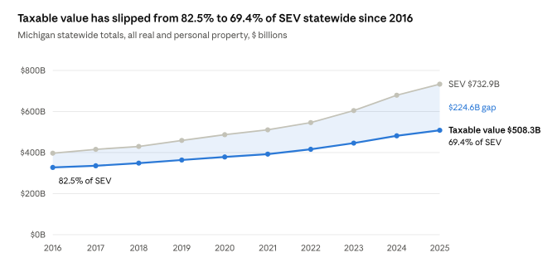
- Taxable value (TV): The value on which property taxes are calculated. Because of Proposal A, TV may be substantially lower than SEV.
A mill is one dollar of tax for each $1,000 of taxable value. A property with $100,000 in taxable value subject to 15 mills of a city or village levy generates $1,500 for that levy. The tax bill may also include levies imposed by other taxing jurisdictions.
Proposal A: Limits on Individual Properties
Proposal A limits annual taxable value growth on an existing parcel to the lesser of inflation or 5%, subject to additions and losses. Following a transfer of ownership, the taxable value uncaps in the following year and is reset to SEV. This increase is commonly called the “pop-up.” While not common, certain transfers, such as those between spouses, do not trigger uncapping. This pop-up is commonly not understood by residents. It is important to note that the pop-up is deferred growth. Without it, property values would be stagnant, and local government would struggle to provide future services.
The State Tax Commission publishes the inflation rate multiplier used to calculate taxable value and Headlee rollbacks via the millage reduction fraction. Proposal A and Headlee both use an inflation factor, but they operate quite differently.
Headlee: Limits on the Community’s Millage Rate
The Headlee Amendment limits certain increases in local taxation without voter approval. When growth in the taxable value of the existing tax base exceeds inflation, a millage reduction fraction may reduce the maximum authorized operating millage rate. New construction and other statutory adjustments are treated differently for this calculation.
Before Proposal A, a reduced maximum millage rate could rise later, aka a “roll-up.” Proposal A effectively eliminated automatic roll-ups when property values did not keep pace with inflation. A Headlee rollback therefore generally reduces the authorized rate on a continuing basis. Voters may approve an override to restore all or part of a previously reduced rate within applicable legal limits.
An additional issue is when property changes ownership, the uncapping or pop-up increase is counted as growth in the existing tax base. This directly impacts the calculation of the millage reduction fraction required for the Headlee calculation. Widespread increases after sales can contribute to a rollback even when the individual property’s taxable value had been capped before the sale. This occurs because it is classifying the pop-up as inflationary growth, likely resulting in a Headlee rollback of the maximum millage rate.
Why It Matters to Your Community
A city or village can face rising costs for employees, infrastructure, and services without a comparable increase in property tax revenue. Declining values during a downturn can reduce the tax base quickly, while Proposal A can slow the recovery of taxable values in later years. New construction and property sales can increase the tax base, but they do not remove these constraints.
MML Policy Priorities
The Michigan Municipal League supports restoring appropriate millage roll-up authority and excluding taxable value increases from ownership transfers when calculating Headlee rollbacks. The League also opposes state property tax changes that reduce municipal revenue without a dependable replacement.
The State Tax Commission publishes the inflation rate multiplier used to calculate taxable value and Headlee rollbacks via the millage reduction fraction. Proposal A and Headlee both use an inflation factor, but they operate quite differently.