Personal Property Taxes
How It Works
Personal property taxes apply to taxable business equipment, machinery, furniture, and other tangible property, rather than land or buildings. Reforms beginning in 2012 exempted substantial categories of business personal property and created state reimbursement mechanisms for eligible local revenue losses.
Businesses report taxable personal property to the local assessor on a statement due February 20. Michigan provides an exemption for qualifying small business property and a separate exemption for eligible manufacturing personal property. Small business owners claim can the exemption with the assessor. Property worth less than $80,000 keeps the exemption once claimed; property worth $80,000 to $180,000 requires a new claim each year.
The small business exemption threshold was increased to $180,000 in combined true cash value beginning with the 2023 tax year, subject to statutory eligibility and filing requirements. Eligible manufacturing personal property was phased out of local taxation over several years. Owners of exempt manufacturing property may owe a state Essential Services Assessment.
Personal property that remains taxable pays local millages, but commercial and industrial personal property is exempt from some or all school operating millage.
How Reimbursements Work
The Local Community Stabilization Authority (LCSA) distributes revenue from the Local Community Stabilization Share of state use tax to reimburse qualifying losses under the personal property tax reforms. State law establishes different payment priorities and methods for eligible essential-service and other losses. Some distributions are tied to historical losses; others depend on the distribution formula and eligible manufacturing property.
The separate Local Government Reimbursement Fund addresses certain losses resulting from the higher small business exemption threshold. Its funding and payment rules differ from the LCSA system. Not every loss is necessarily reimbursed in full.
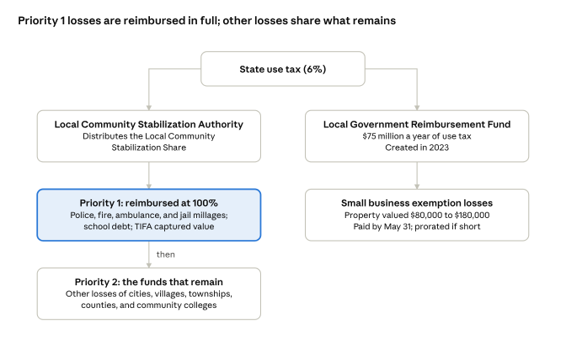
How personal property tax losses are reimbursed | Source: Michigan Treasury / HFA
Why It Matters to Your Community
Local officials should work with assessors and finance staff to check eligible losses, compare reimbursement estimates with Treasury data, and meet correction deadlines. Because payments may arrive outside the municipality’s fiscal year, budget projections should reflect the expected payment schedule.
MML Policy Priorities
The Michigan Municipal League supports replacing municipal revenue lost through state personal property tax exemptions, with payments that are sufficient and timely. The League has also opposed eliminating additional local tax revenue without a dependable replacement. House Bill 5878 of 2026 would eliminate personal property taxes. The source draft reports that it passed the House in May 2026 and was pending in the Senate as of October 2026.