Municipal Budgeting
A municipal budget authorizes spending and sets financial priorities. Michigan’s Uniform Budgeting and Accounting Act (1968 PA 2) governs budget preparation, public review, appropriations, amendments, and reporting.
How It Works
A city or village must adopt its general appropriations act before the fiscal year begins. State law requires a balanced budget, which can include legally available fund balance. But using fund balance to meet this year’s spending plan does not necessarily provide a lasting way to pay recurring costs.
The chief administrative official prepares the proposed budget as provided by state law and the municipality’s charter or other governing law. This is typically the manager, mayor or village president, but check your local charter. The governing body reviews the proposal, provides required public notice and a hearing, adopts appropriations, and authorizes any necessary amendments. The charter may impose additional requirements.
A Practical Budget Cycle
- Preparation: Issue budget guidelines, estimate taxable values and revenues, and review department requests.
- Proposed budget and public review: Submit the proposed budget, hold work sessions, publish required notices (including Truth in Taxation, if applicable), and hold the public hearing.
- Adoption: Adopt the budget and levy resolution before the fiscal year begins.
- Monitoring: Review budget-to-actual reports throughout the year.
- Amendment: Approve necessary changes before expenditures exceed the amounts legally authorized.
The Act provides consequences for certain knowing or unauthorized violations of appropriation controls. As a practical matter, there may be the occasional circumstance where a resolution to amend the budget may follow the expenditure, particularly in an emergency circumstance.
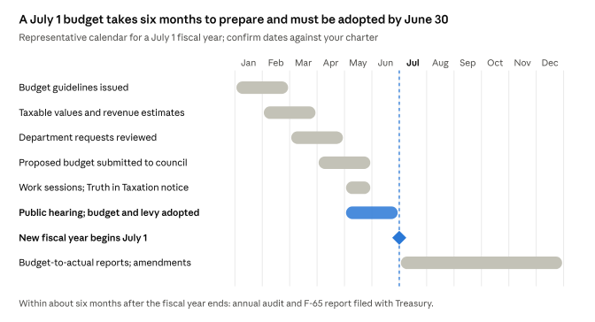
Illustrative annual budget calendar for a July 1 fiscal year. Confirm deadlines against your charter.
Understanding Municipal Funds
- General Fund: Core governmental operations, including many administrative and public safety services.
- Special revenue funds: Resources dedicated or restricted to particular purposes, such as Major Street and Local Street funding.
- Debt service and capital projects funds: Financing debt payments and major construction.
- Enterprise funds: Services such as water or sewer are supported primarily through customer charges.
- Other funds: Internal service and fiduciary funds account for specific activities and responsibilities.
Questions Every Official Should Ask
- Are recurring revenues sufficient to cover ongoing operating costs?
- Does the municipality have a fund balance policy, and is recurring fund balance use sustainable?
- Are financial reports provided often enough to detect emerging problems?
- Are budget amendments adopted before appropriations are exceeded?
- Does the capital improvement plan account for future repair and replacement costs?
- Does a multi-year forecast show how today’s decisions affect future budgets?
Why It Matters to Your Community
Adopting a balanced budget is only part of a community’s financial responsibility. Local officials must also consider whether ongoing revenues can support services, infrastructure, and other commitments in future years. A multi-year forecast can help identify problems before they require service cuts or emergency action.
MML Policy Priorities
Municipal budgeting is included here as an educational topic rather than a standalone current Michigan Municipal League legislative priority. The League’s Municipal Finance Handbook and training resources offer further guidance.