Local Road Funding
Public Act 51 of 1951 governs the distribution of much of Michigan’s state road revenue to cities and villages. The Michigan Transportation Fund (MTF) receives money primarily from fuel taxes and vehicle registration fees. Act 51 also sets rules for accounting for and spending local street revenue.
How It Works
Cities and villages account for state road revenue in separate Major Street and Local Street special revenue funds, not the General Fund. Act 51 restricts how the money may be spent. Street funds can also receive local taxes and transfers when permitted by law.
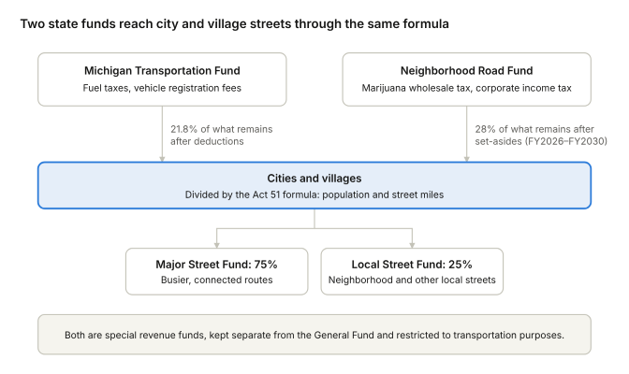
How state road funding reaches city and village streets. Source: Act 51 (MCL 247.651 et seq.); 2025 PA 16.
What Changed in 2025 & 2026
Michigan changed several transportation taxes and distributions in 2025. Beginning January 1, 2026, sales tax no longer applies to fuel, and the motor fuel tax increased to a 51-cent base indexed to inflation. The package also created the Neighborhood Road Fund. This fund receives revenue from a new 24% wholesale marijuana tax, which faces a court challenge, and a share of corporate income tax revenue. Local officials should pay attention as projected distributions may differ from money actually received.
Under the Neighborhood Road Fund framework applicable in fiscal years 2026 through 2030, the portion distributed among road agencies is allocated 52% to counties, 28% to cities and villages, and 20% to state trunklines after specified program allocations. The statutory formula changes beginning in FY2031, so the initial percentages should not be presented as permanent. Treasury directs local governments to account for NRF receipts in the applicable street or road special revenue funds.
Spending & Transfers
Act 51 restricts eligible road expenditures and sets conditions for transfers between Major Street and Local Street funds. It also includes requirements for administration, certain nonmotorized improvements, and annual reporting to MDOT. Finance and public works staff should check current MDOT guidance before committing funds.
Why It Matters to Your Community
The new funding gives communities an opportunity to address overdue street repairs and maintenance. Before committing it, local officials should compare expected distributions with road condition data, the capital improvement plan, and planned projects. Estimates should be updated as tax collections and any litigation affecting the funds develop.
MML Policy Priorities
The Michigan Municipal League supports dependable transportation funding sufficient to maintain city and village streets. The League is monitoring implementation of the 2025 package, including Neighborhood Road Fund spending rules and developments that could affect the revenue available.