CEA 2025: Downtowns
By: Emily Landau,
September 8, 2025
In the final entry in our series about the 2025 Community Excellence Award submissions, we take a look at three Michigan cities in the process of tackling one of the biggest projects of all: reviving and reimagining their downtowns.
Isn’t It Iron-ic: Negaunee Revives Its Past
2025 Community Excellence Award Entries: Downtowns
Negaunee has always had a downtown, but it wasn’t always as lovely as it is now.
For years, the downtown corridor along Iron Street was marked by a sense of desolation: cracked sidewalks, vacant and dilapidated storefronts. “It was in rough shape, but it had a great future if certain things were concentrated on,” says City Manager Nate Heffron. “If you don’t change, you evaporate. And that’s what Negaunee was heading towards, evaporation—becoming a town where buildings are falling down.”
“There wasn’t much of a streetscape at all,” says Mona Lang, a Marquette-based consultant and former DDA executive director. “It was locally known for the number of bars and not much else.”
That all started to change in 2020. Heffron and the City Council brought in Lang, who helped to restart Negaunee’s Downtown Development Authority. As luck would have it, Revitalization and Placemaking (RAP) grants became available just as the City was beginning the overhaul. “As resources became available, we were able to really do a full, total facelift,” says Lang. “More than facelift—a total, complete re-envisioning of downtown.” Smash cut to a few years later, and Negaunee’s transformed, iron-themed downtown is the City’s entry for the 2025 Community Excellence Award.
Things began with a complete water infrastructure replacement project, the funding for which the City was able to tie in with the RAP grant. “I guess you’d call it dumb luck,” says Heffron. “Money due to Covid kind of fell into our lap.”
“The timing was absolutely perfect,” says Lang.
“We had to fix the bones of the community—water, sewer, electric, all the things that people don’t see but come to rely on,” says Heffron. “We didn’t want to just slap makeup on it and say, Oh, we’re looking good now.”
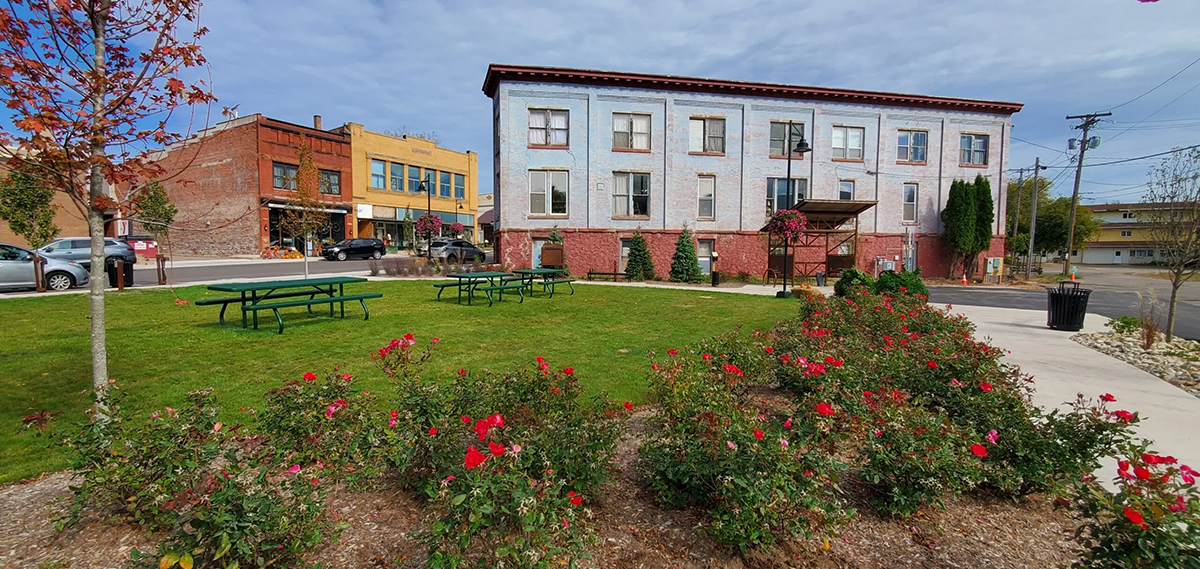
Above ground, Iron Street was remade with wider sidewalks, benches, bike racks, and attractive landscaping that beckoned pedestrians to linger. A section of Marquette Street was permanently sectioned off with bollards; thus, Iron Town Plaza was born, a new pedestrian area featuring Adirondack chairs, planter boxes, and decorative lighting features connecting it to the Iron Ore Heritage Trail.
 “Walking in this plaza, there’s columns that light up at night and they change different colors,” says Heffron. “You got these Edison lightbulbs zigzagging back and forth—just this really neat, inviting place that’s surrounded with landscaping. It’s very comfortable and it takes you right to the downtown.”
On the subject of iron: The downtown has new branding to match, honoring Negaunee’s history as a center of iron mining in the Upper Peninsula. Its motto, “Forge Your Adventure,” pays homage to the industry and hints at Negaunee being a gateway to outdoor recreation.
Iron Town Plaza faces the Vista Theater, an historic building that had suffered a roof collapse right as planning for the project was underway. Demolition was proposed. “It’s a landmark building in downtown,” says Lang. “I’m like, Oh my God, you cannot tear it down.” Eventually, the City was able to secure funding from the state to save the Vista. “It’s going to be slow, but they are working on revitalizing, restoring, and reusing that building,” says Lang.
“One day, we hope to bring forward [the rehabilitation of the Vista Theater] as a Community Excellence Award,” says Heffron.
Storefronts that once sat idle are being upgraded, drawing people into the new, prettier, more pedestrian-friendly spaces. “When the city invests in itself, private investment follows,” says Heffron. “I always say that it’s contagious,” adds Lang, “One property owner steps up, and then the next property owner follows, and then the next. It’s a domino effect.”
The ribbon cutting in September 2024 marked the project’s completion, and residents turned out to celebrate. Once overlooked, downtown Negaunee feels like a place again. “One guy told our mayor, ‘I used to be embarrassed to tell people where I was from, because the place looked like a dump,’” says Heffron. “And he said, ‘But not today.’ He was crying.”
“People remember this town being hopping,” continues Heffron. “Like all downtowns back in the day, in the 1970s and 1960s before all the big mega-stores and everything moved in. And then, the community started dwindling. And now, it’s having a resurgence because we’re reinvesting in our community—in the downtown.”
Adds Lang: “Negaunee has turned into one of those little towns that you go into and say, Oh, I had no idea this was here. This is really cool.”
With Nankin Square, Westland Evolves Beyond the Mall
2025 Community Excellence Award Entries: Downtowns
Opened in 1965, the million-plus-square-foot Westland Shopping Center mall is not just a distressed property; it’s an iconic distressed property. Its top search hit is a photo series posted on the Reddit community /r/deadmalls. “It was like an enclosed downtown. Grocery store, drug store, all the local Detroit clothing and shoe store chains, a butcher shop, two bookstores, a USPS station, and several restaurants,” reminisced one user. “It was a busy place. At Christmastime, the parking lot would fill completely.”
Fun fact! The City of Westland is named after this mall, not the other way around. Slightly less fun fact: The mall’s vacancy rate today is over 50 percent, another victim of the nationwide decline of shopping malls that began after the 2008 economic crash. Writes one recent Google reviewer: “Everything is basically closed up.”
“The city literally incorporated to keep that mall from becoming part of Livonia,” says Westland Chief Business Development Officer Alex Garza. “And then, what we were named after—what a lot of people consider the identity of the city—starts to die.”
The Westland Mall and the City of Westland are so profoundly intertwined that even residents often assume that the mall is owned by the City, which Garza and Business Retention and Expansion Coordinator Brendan Schroder would like to inform readers is very much not the case. Faced with the task of separating the identity of Westland from a private entity whose ownership marches to the beat of its own drum, the City decided to be bold.
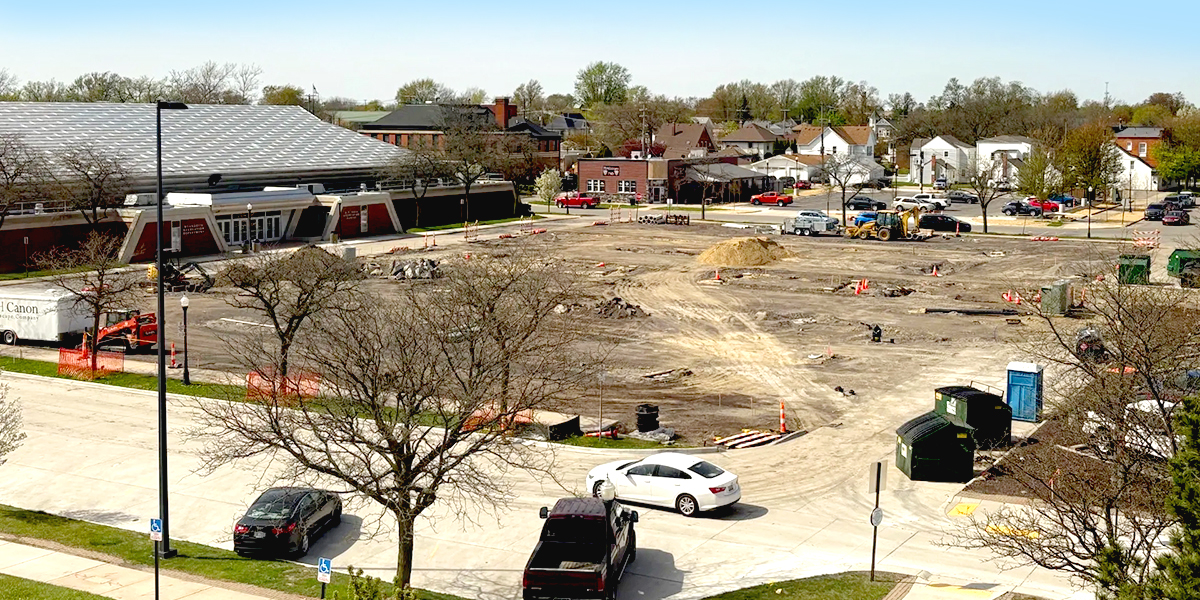
It began ten years ago, when City Hall moved from its earlier location on Ford Road to Warren Road about a half mile from the mall, the site of a vacant strip mall. Westland bought that parcel, and soon enough the old Circuit City was renovated into “an awesome new City Hall.” From there, an idea sprouted, revitalizing the whole area into a gathering place for the humans of Westland. This vision, called Nankin Square, is scheduled to open in the fall of 2025, and is Westland’s entry for the 2025 Community Excellence Award.
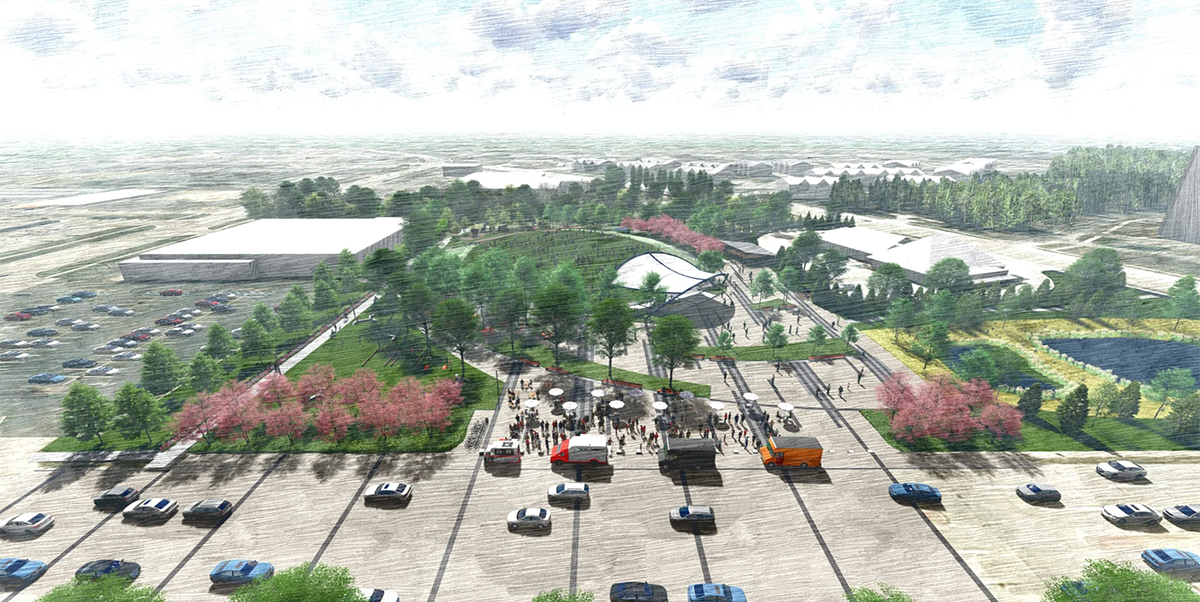
Nankin Square is a complete re-envisioning of the neighborhood around Nankin Boulevard, with the mall to the east and the new City Hall to the west. One of the project’s major inspirations was Columbus Commons in Columbus, OH. “There was a mall there … they were able to get site control, demolish it, and they made it into a community gathering space. They host concerts, they host movies, they do yoga in the park, taco trucks,” says Schroder. “And we had a perfect parcel of City-owned land right here next to City Hall. And then we were like, ‘Well, wait, why don’t we do that here?’”
Funding for the project was the result of collaboration between many actors. $8.5 million came from Westland’s Tax Increment Finance Authority (TIFA) Board, $2.5 million from Wayne County’s ARP fund, and $1 million from an MEDC Revitalization and Placemaking (RAP) grant. Last but far from least, the City received a $250,000 grant through its U.S. House Representative, Rashida Tlaib.
One of the centerpieces of Nankin Square is an amphitheater and great lawn with capacity for up to 3,000 people, which the City hopes to use to host local and national music acts. “[The amphitheater] really is unique in that it feels like an extension of the park instead of an amphitheater inside a park,” says Schroder.
The square will also feature a large multi-use space with outdoor games including bocce, foosball, and cornhole. Two playgrounds, a beer garden, chess tables, and picnic area round out the pedestrian area, while Nankin Boulevard is being overhauled with a road diet and bike lanes.
As for the iconically declining mall that is Westland’s namesake? The City is hopeful that Nankin Square might prove to be what Schroder describes as “an economic catalyst, an Archimedes Lever” to inspire the current ownership into something more modern, perhaps mixed-use development or a public–private partnership. But the vision of Nankin Square no longer needs it. The “indoor downtown” that once was the mall will soon be transferred right next door—a real, outdoor downtown.
“We’re trying to create a space where the community can come together,” says Garza. “This is a way for us to really wrap folks into this, creating more of a festive atmosphere. This is something that we want to be the norm in Westland, for people to feel like they have somewhere to come to.”
“
This is a way for us to really wrap folks into this, creating more of a festive atmosphere.
Nankin Square is a complete re-envisioning of the neighborhood around Nankin Boulevard, with the mall to the east and the new City Hall to the west. One of the project’s major inspirations was Columbus Commons in Columbus, OH. “There was a mall there … they were able to get site control, demolish it, and they made it into a community gathering space. They host concerts, they host movies, they do yoga in the park, taco trucks,” says Schroder. “And we had a perfect parcel of City-owned land right here next to City Hall. And then we were like, ‘Well, wait, why don’t we do that here?’”
Funding for the project was the result of collaboration between many actors. $8.5 million came from Westland’s Tax Increment Finance Authority (TIFA) Board, $2.5 million from Wayne County’s ARP fund, and $1 million from an MEDC Revitalization and Placemaking (RAP) grant. Last but far from least, the City received a $250,000 grant through its U.S. House Representative, Rashida Tlaib.
One of the centerpieces of Nankin Square is an amphitheater and great lawn with capacity for up to 3,000 people, which the City hopes to use to host local and national music acts. “[The amphitheater] really is unique in that it feels like an extension of the park instead of an amphitheater inside a park,” says Schroder.
The square will also feature a large multi-use space with outdoor games including bocce, foosball, and cornhole. Two playgrounds, a beer garden, chess tables, and picnic area round out the pedestrian area, while Nankin Boulevard is being overhauled with a road diet and bike lanes.
As for the iconically declining mall that is Westland’s namesake? The City is hopeful that Nankin Square might prove to be what Schroder describes as “an economic catalyst, an Archimedes Lever” to inspire the current ownership into something more modern, perhaps mixed-use development or a public–private partnership. But the vision of Nankin Square no longer needs it. The “indoor downtown” that once was the mall will soon be transferred right next door—a real, outdoor downtown.
“We’re trying to create a space where the community can come together,” says Garza. “This is a way for us to really wrap folks into this, creating more of a festive atmosphere. This is something that we want to be the norm in Westland, for people to feel like they have somewhere to come to.”
Wyandotte Gives Itself a Dumpster-Hiding Makeover
2025 Community Excellence Award Entries: Downtowns
“It was really a snowball effect, I think, is the best way to describe it,” says City of Wyandotte DDA Director Joe Gruber.
As one of Michigan’s oldest incorporated cities (since 1866), Wyandotte found itself dealing with the difficult reality that much of its downtown infrastructure—alleys, sewers, parking lots—was getting up there in years. Crumbling pavement, failing utilities, and outdated layouts had become impossible to maintain with patchwork fixes. The City decided a more comprehensive solution was needed.
“The DIP,” Wyandotte’s Downtown Infrastructure Project, is the result of that process, a $13 million downtown revitalization effort tackling multiple human lifetimes’ worth of aging infrastructure—while setting up a canvas for longer-term growth and beautification. Now nearly complete, the DIP is the City’s submission for the 2025 Community Excellence Award.
Planning for the project began before the pandemic began in 2020. “The problem was the infrastructure was old … 70, 80, 90 years old,” says Mayor Robert DeSana. “Imagine crumbling alleyways, potholes—I can’t even say cracks, because everything was basically disintegrating. It was so, so bad. It got to a point where we couldn’t even maintain it.”
Realizing that incremental repairs would not be enough, and that individual repairs compounded onto each other, the City adopted the philosophy of (as Gruber says) “Let’s do it right, and let’s do it once.”
With the arrival of federal ARP funds—which DeSana credits with making the entire project possible—what was once an “ideal world” scenario suddenly entered the realm of the possible. An unexpectedly major player in the early discussions? Dumpsters.
“The snowball came because we looked at placement and location of dumpster enclosures,” explains Gruber. “Building dumpster enclosures was something we couldn’t do, because we had all these large overhead utility lines and utility poles. So, then we explored burying those. Well, then, if we were going to do that, we might as well reconstruct the entire parking lot.”
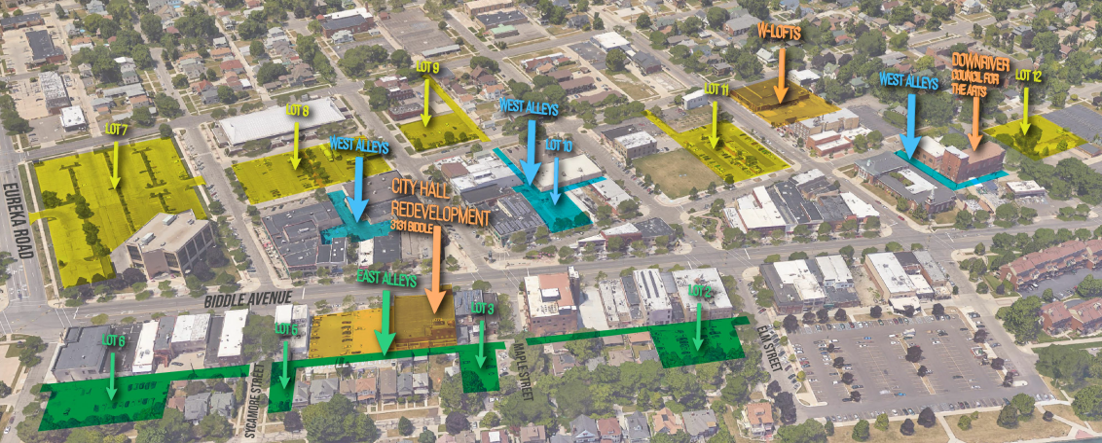
The snowball got bigger. “The engineering department said, well, if we’re going to [rebuild the municipal parking lots,] we might as well get all the sewer lines repaired,” says Gruber. “And then we might as well [re-do] the underground stormwater management systems.”
Clearly, this was going to be a big project, one which Gruber and DeSana realized Wyandotte residents might have opinions about. Over the next two years, the City held meetings with residents to gather input and explain the scope of the work. “The can was kicked down the road long enough,” says DeSana. “It didn’t take a lot of convincing to get people to understand … that something had to be done. That upfront engagement definitely helped answer a lot of questions.”
In addition to the transformative effect of ARPA cash and city bonds, Wyandotte also received funding from MEDC, the Ralph C. Wilson, Jr. Foundation, and SEMCOG. Construction lasted about 11 months, finishing on time for events like the Fourth of July parade and the Wyandotte Street Art Fair. Crews (many of them in-house) excavated, buried power lines, rebuilt sewers, and installed stormwater detention systems to protect the Detroit River.
The work uncovered bits and bobs of Wyandotte history. Workers kept digging up vintage glass bottles, due to the presence of a Coca-Cola bottling plant and the historic Marx breweries along the river. Due to the presence of Eureka Iron Works, the first Bessemer steel mill in the United States, “the guys were always finding pieces of slag, which is the byproduct of the iron works,” says Gruber. “There was tons of that.”
Simply making dumpsters less conspicuous considerably improved the aesthetics of downtown, but there is more to come. The next six to nine months “will see a lot of placemaking and beautification,” says Gruber. “We did a couple of pocket parks—small little gathering areas—and we’re going to continue to do what we’re calling ‘the cherry on top’—artwork installations, lighting installations, more signage and wayfinding to really build out this infrastructure.”
Today, despite being one of the oldest cities in Michigan, Wyandotte can claim to have some of the newest downtown infrastructure in Wayne County. What once drew complaints now draws praise. “I hear it all the time,” says Gruber. “People come back and they say, ‘God, what you guys have done is just incredible.’”
Author
Emily Landau
Emily is the League’s full-time Content Writer, composing emails, articles, blog posts, and press releases. If you need words, she has many. Prior to becoming a word person, she was a restaurant person, handling catering, event management, and marketing; prior still, she was a teaching person, at a private boarding school in Massachusetts. Having earned a master’s degree in Classics from the University of Georgia, Emily is confident that she is the only League employee fluent in Latin. She also enjoys cooking, stand-up comedy, and is an avid gamer, having achieved level 40 on her Steam profile.