West Branch Merchants on Main Street Make-Over: “We Don’t Have 5 or 6 Years to Wait”
By: Elizabeth Shaw,
February 27, 2013
A recent visit to West Branch was a great reminder to me that placemaking is never “place made.” It’s an ongoing process as a community continues to evolve.
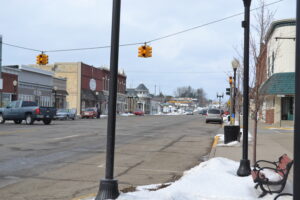 A few years ago, West Branch launched a placemaking campaign focused on cultural economic development strategies for their downtown Main Street businesses. The result was Fabulous Fridays, featuring weekly themed events throughout the summer that have boosted overall business 10-15 percent annually for the entire downtown.
Now city officials are focusing on physical design and walkability as the next phase in their placemaking battle plan.
Last fall, the Michigan Department of Transportation rebuilt the I-75 business loop at exits 212 and 215 into West Branch. City leaders want to make sure an impending MDOT project through town will include elements to make Houghton Avenue more bike- and pedestrian-friendly, instead of just a better thru-way for trucks and cars.
“We want to make sure we’re ahead of the game in going to MDOT with a plan saying this is how we’d like our downtown-now help us build it,” said City Manager Tom Youatt. “We realize this is a once-in-a-generation opportunity and we want to be sure we do it wisely and we do it right.”
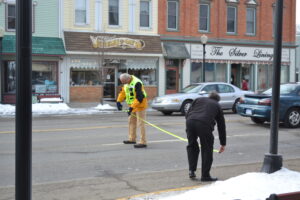 They started by bringing in national expert Dan Burden to do a walkability audit of the downtown, inviting local merchants, MDOT representatives, city staffers, and local media to walk along.
Despite being the city’s Main Street, Houghton Avenue is a multi-lane major truck route straight through the heart of town. And with one traffic light and no marked crosswalks, it’s the rare chicken who would risk getting from one side to the other. It’s the biggest challenge for merchants working to revitalize the shopping district, said Silver Lining boutique owner Peter Fabbri.
“You can’t have outdoor seating with double-trailer logging trucks roaring past,” said Fabbri, who was shouting to be heard above the screech of a passing semi’s air brakes. “I’ve got an 80-year-old tenant living upstairs and she can hardly stand the noise. It literally shakes my 114-year-old building. The only reason they’re doing it is because they can. We’ve got to quit treating this road like a super highway and treat it like what it is: the main thread in the fabric of our town.”
Burden’s suggested “road diet” would take Main Street down from five lanes to two, framed by clearly painted “transition lanes” to act as both traffic buffer and bike lanes. A roundabout at the main intersection would smooth traffic flow and offer a central focal point for the downtown.
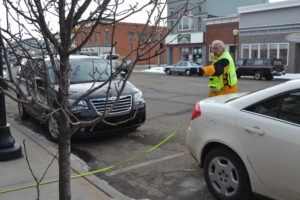 More surprising to participants was his idea to reclaim some of the existing sidewalk’s unused “furniture zone” at the outer edge, using it to add back-in angled parking, with curb extensions at the intersections to increase pedestrian visibility and safety, frame in the new parking, and add potential seating and ornamental features. That and more trees would create that all-important sense of enclosure that’s currently missing, Burden said. Downtown buildings should also be required to have 70-90% glass on their storefronts to provide a sense of security and transparency and to offer more diversity and “eye appeal.”
Requiring more windows would just take changing the local building ordinance. Other improvements would require changing a state law, like one banning angle parking on a state highway, even through a city’s downtown.
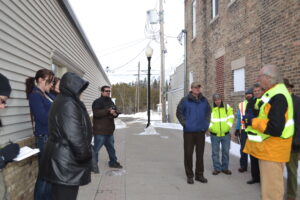 Two currently unused spaces between buildings (called a paseo or alley) could be great moneymakers for adjacent eateries and other businesses, he said, by converting them to beautiful outdoor living areas with seating and other features that create a sense of “to go-ness.”
Creating a visual “gateway” at the Rifle River Bridge at the central business district’s east end would make drivers feel they’ve arrived at a real place, Burden said, naturally enticing them to slow down and maybe even stop for a closer look. With the soon-to-be-extended River Walk here, it’s also the perfect spot for a much-needed mid-block crosswalk.
The MDOT project isn’t slated until 2019-2020 so that gives the city plenty of time to develop a plan, seek out potential funding and-most importantly-build community support for a unified vision of the future downtown, said Youatt. But with the right motivation, that timeline could be moved up.
“Just because that process has always taken five to six years doesn’t mean it has to be that way. If we all do our part locally, maybe we can get bumped up sooner in MDOT’s schedule,” said Youatt.
Fabbri agreed.
“I understand timelines but pushing the envelope is something we should be looking at,” said Fabbri. “It’s been shown these kinds of changes can increase local business up to 30 percent. We’ve got businesses working really hard to stay afloat right now. Some might not have five years or more to wait.”