East Lansing Puts People First
By: Emily Pinsuwan,
May 26, 2026
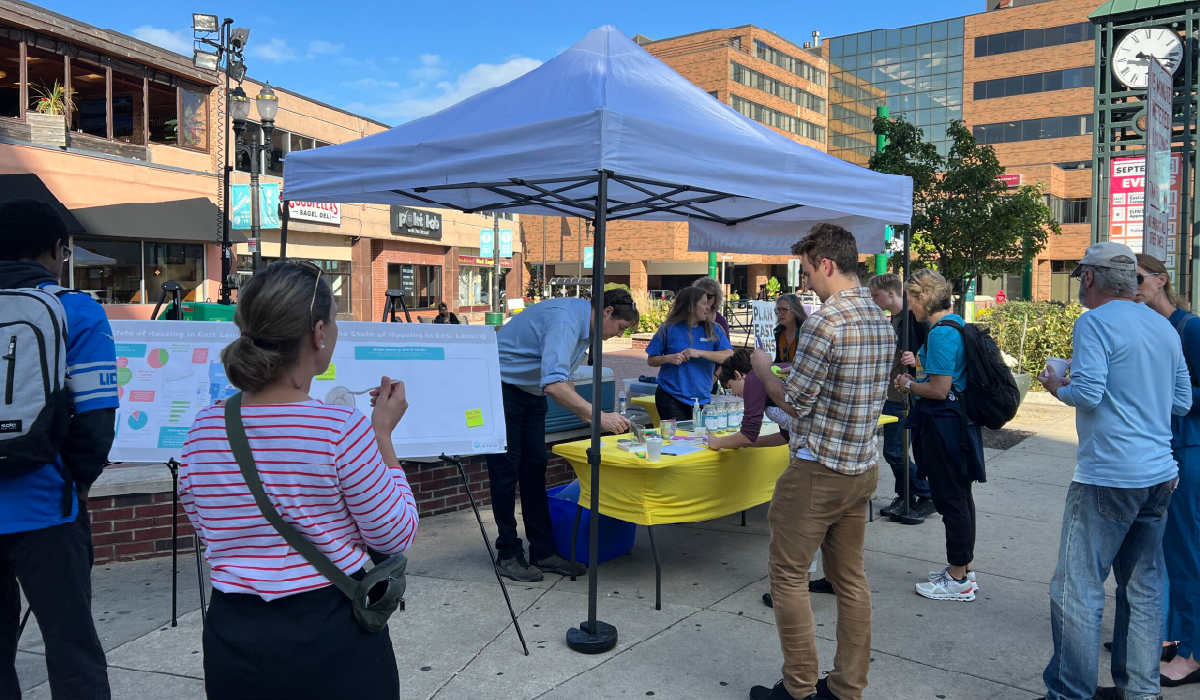
Comprehensive Plan updates can be routine: Revising technical language, updating demographic information, guidelines for utilities. The City of East Lansing decided to take things a step further. For their five-year update in 2023, the City used their Comprehensive Plan update process as an opportunity to broaden the scope of the plan, involving residents in defining who they want to be in the future.
“Some communities have a meeting, you know, a public hearing, and that’s it,” says Landon Bartley, Principal Planner for the City of East Lansing. “We didn’t really want to do that. We wanted to have the community to have a chance to really weigh in on topics that they had chosen as most important.”
East Lansing’s previous Comprehensive Plan, adopted in 2018 and titled “The Bigger Picture,” already addressed issues such as housing and development. “Around the time that the Planning Commission said, ‘Go forth and update,’ we did a couple of community meetings,” said Bartley. “There’s a community event at our community center called Winter Fest, and basically, we just said, ‘What is your highest priority?’”
Those initial meetings began a yearlong process of dialogue. “I would characterize what we did as a large amount of community engagement for what could be a minor update,” he adds.
The result of that process is now reshaping how the city approaches what residents identified as four priority areas of focus: housing, sustainability, public health, and social equity. Adopted in 2025, East Lansing’s Comprehensive Plan Update, titled “The Bigger Picture: In Focus” is the City’s entry for the 2026 Community Excellence Award.
Throughout 2024, the City hosted monthly community engagement events with speakers, workshops, and activities focused on each of the four priority areas. To set the stage, John Kamp and James Rojas—authors of the book Dream, Play, Build—hosted an interactive workshop to identify East Lansing’s shared community values. Diversity consultant Vernā Myers spoke about social equity and “how we make sure that all members of the community are really being considered and listened to,” says Bartley. There was a panel discussion on public health with Ingham County health officials. Danielle Arigoni, author of Climate Resilience for An Aging Nation, gave a talk, as did Ryan Kilpatrick, a housing expert with Housing Next.
Talkback sessions followed each event, “just to make sure that we’re covering the whole spectrum of people in our community,” says Bartley.
A Coordinating Committee composed of residents, commission members, housing and environmental advocates, transportation representatives, health officials, and Michigan State University stakeholders guided the process. “We recognize that there are going to be people affected by this plan that can’t participate for whatever reason,” says Bartley. “So, we were counting on members of our Coordinating Committee to look out for those voices that couldn’t be at the table.”
Urban planning students at MSU, working on their capstone project, conducted campus meetings and online surveys specifically focused on the university population, which makes up a significant portion of East Lansing but tends to be underrepresented in long-term planning discussion. “We want to have college students engaging college students,” says Bartley. “Their goal was to engage a statistically significant number of students and they got there. So, it was very impressive on their part.”
Social equity was identified as a major theme of the update from early in the process, and it ultimately became the overarching theme of the entire initiative. “I differentiate social equity from equality in that equity is essentially redirecting resources to where they haven’t been directed before,” says Bartley.
The engagement process revealed evolving attitudes about housing and development within East Lansing. “Moreso than I was expecting, there is an acceptance in the community: more housing is needed,” says Bartley. “I expected more pushback on that. It was more like, ‘Yeah, we get it.’”
Instead, what the sessions revealed was that residents wanted intentional housing growth that respected East Lansing’s pre-existing character. “We need more housing. Where is it going to make the most sense? We got some fairly good direction,” he says. “Where it makes most sense is where it’s already more dense, where we already have business districts. That’s a fairly easy way for me to start changing policies and updating the zoning ordinance. So, we’ve already been able to see some early implementation, because we got clear messages from the community.”
Significant flooding occurred during the planning process, lending greater urgency to the priority area of sustainability. “I think that kind of helped put people’s minds in the right sort of frame,” says Bartley. Resident discussions showed an increased interest in connecting development with stormwater management and long-term sustainability. “People were saying, ‘Wow, yeah, we need to consider what are the environmental impacts of our built environment.’”
Public health conversations resulted in an expanded view of how things such as walkability or bike-ability can contribute to resident well-being. “Public health doesn’t have to be about being in shape and going to the gym,” says Bartley. “It’s about access to fresh food. It’s about access to natural active recreation. It’s about not having to be in your car every day.” The updated plan reflects this broader understanding of how transportation systems and neighborhood design contribute to community health outcomes.
East Lansing’s updated plan, “The Bigger Picture: In Focus” was formally adopted by the Planning Commission in August 2025. Local boards have begun referencing the plan directly in meetings and discussions, using it both as a guide for future action and as a tool for accountability.
And, of course, residents are already familiar with the plan—because they helped write it. “I already have people come to meetings with the document and point to it,” says Bartley. “They say, ‘Hey, you say right here in this chapter that this is a priority. We talked about this. Let’s make it happen.”
Author
Emily Pinsuwan
Emily is the League’s full-time Content Writer, composing emails, articles, blog posts, and press releases. If you need words, she has many. Prior to becoming a word person, she was a restaurant person, handling catering, event management, and marketing; prior still, she was a teaching person, at a private boarding school in Massachusetts. Having earned a master’s degree in Classics from the University of Georgia, Emily is confident that she is the only League employee fluent in Latin. She also enjoys cooking, stand-up comedy, and is an avid gamer, having achieved level 40 on her Steam profile.